

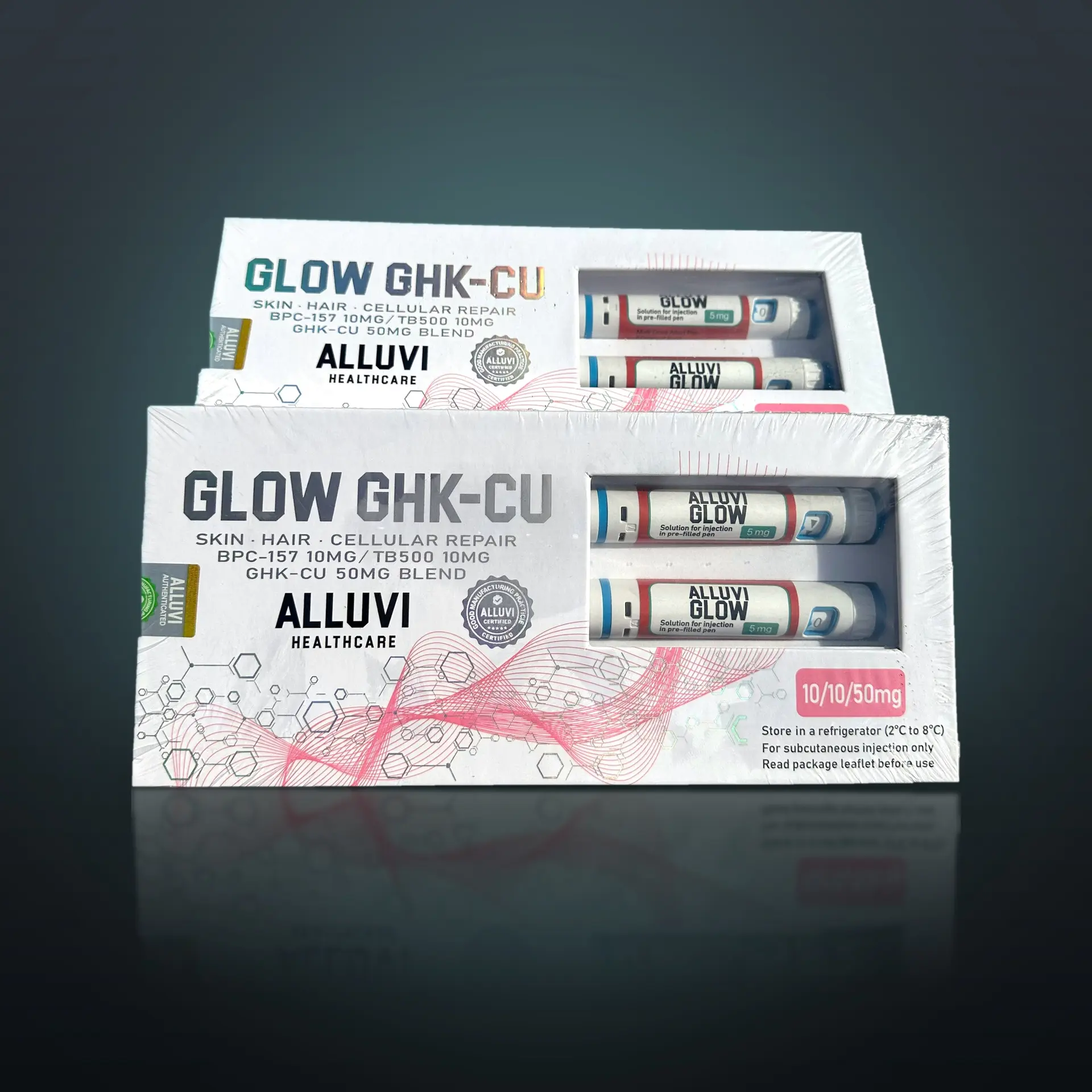
GLOW70 Peptide Pen: Advanced Research Guide
What Is GLOW70 Peptide Pen?
GLOW70 Peptide Pen is a research-oriented peptide blend presented in a pen format. Current product listings commonly describe GLOW70 as a 70 mg combination of three peptides: GHK-Cu, BPC-157, and TB-500. A commonly listed formulation contains 50 mg of GHK-Cu, 10 mg of BPC-157, and 10 mg of TB-500.
The combination has attracted interest in laboratory research involving extracellular matrix biology, cellular signaling, tissue biology, and peptide interactions. The pen format is a product presentation rather than evidence of a particular medical application.
Exact composition, purity, packaging, and testing can differ between manufacturers. Researchers should therefore check the product label and batch-specific Certificate of Analysis before using a particular GLOW70 Peptide Pen in laboratory work.
Understanding the GLOW70 Formula
The three components commonly associated with GLOW70 are GHK-Cu, BPC-157, and TB-500.
GHK-Cu
GHK-Cu is a copper-binding peptide that has been investigated in areas including extracellular matrix biology, collagen-related research, cellular signaling, and skin biology.
Because GHK-Cu interacts with copper, researchers may investigate its relationship with copper-dependent biological processes and cellular pathways.
BPC-157
BPC-157 is a synthetic peptide that has been investigated primarily in preclinical research. Studies have examined various biological processes involving cellular signaling, vascular responses, and tissue-related models.
The majority of evidence surrounding BPC-157 comes from experimental research rather than established clinical applications.
TB-500
TB-500 is commonly associated with research involving thymosin-related peptide sequences and cellular processes such as migration and tissue biology. Terminology surrounding TB-500 can vary between suppliers, so researchers should verify the exact identity and sequence specified in their product documentation.
Research Applications
Research involving GLOW70 Peptide Pen may involve studying the individual components separately or examining interactions between multiple peptide pathways.
Potential research areas include:
- Extracellular matrix biology
- Cellular signaling
- Skin and connective-tissue research
- Peptide interaction studies
- Tissue-model research
- Copper-peptide biology
- Cellular migration models
- Experimental regenerative biology
Combining several research peptides into one preparation can be useful for experimental models examining multiple biological pathways. However, the presence of several compounds does not by itself establish that they produce a synergistic biological effect.
Researchers should evaluate each component independently and consider the limitations of the available evidence.
Why the Three-Peptide Combination Is Studied
One reason GLOW70 Peptide Pen has attracted attention is that its components represent different areas of peptide research.
GHK-Cu is associated with copper-dependent signaling and extracellular matrix research, while BPC-157 and TB-500 have been investigated in various preclinical models involving cellular and tissue processes.
A multi-component formulation therefore provides a research model for investigating several pathways within the same experimental preparation.
However, combination research requires careful experimental design. Results obtained from one peptide cannot automatically be attributed to the complete blend, and results from a blend cannot necessarily be attributed to a particular individual component.
Product Specifications
When evaluating a GLOW70 Peptide Pen, researchers should verify the specifications supplied by the manufacturer.
Commonly listed GLOW70 formulations contain:
- GHK-Cu: 50 mg
- BPC-157: 10 mg
- TB-500: 10 mg
- Total peptide content: 70 mg
- Format: Pre-filled or ready-to-use research pen
These specifications are commonly listed by current suppliers, but they should not be assumed to apply to every GLOW70 product. Batch documentation and the manufacturer’s product label should take precedence.
Other information worth checking includes the lot number, purity, analytical testing, manufacturing information, and storage requirements.
Purity and Quality Documentation
Quality documentation is particularly important when working with a multi-component peptide product.
For GLOW70 Peptide Pen, researchers may want to review documentation covering peptide identity, purity, quantity, and batch information. Depending on the supplier, testing may include HPLC analysis, mass spectrometry, endotoxin testing, or other quality-control procedures.
A Certificate of Analysis should ideally correspond to the specific batch being supplied. Researchers should also distinguish between a report covering individual components and a report that specifically analyzes the finished GLOW70 formulation.
This distinction matters because testing individual ingredients does not necessarily establish the composition or purity of the complete finished product.
Storage and Handling
Storage requirements should be taken directly from the manufacturer’s documentation for the specific GLOW70 Peptide Pen.
Peptide stability can be affected by temperature, light, moisture, formulation, and other environmental factors. Different products may therefore have different storage requirements.
Researchers should keep the product in its original packaging where appropriate and follow the supplier’s documented storage instructions. Laboratory handling should also follow applicable institutional safety procedures.
Safety Considerations
A research-grade GLOW70 Peptide Pen should not automatically be considered suitable for human use.
The individual components have been investigated in experimental models, but research findings do not establish that a particular combination, formulation, or pen product is safe or effective for human administration.
Researchers should also consider that combining multiple biologically active research compounds introduces additional variables into an experiment. The safety profile of a combination cannot simply be assumed from studies of its individual components.
Appropriate laboratory safety procedures and the manufacturer’s safety documentation should be followed when handling research materials.
How to Evaluate a GLOW70 Peptide Pen
Before selecting GLOW70 Peptide Pen for laboratory research, check:
- Composition: Confirm the listed amounts of GHK-Cu, BPC-157, and TB-500.
- Total quantity: Verify the stated 70 mg total peptide content where applicable.
- Identity: Review available analytical confirmation for each component.
- Purity: Check the manufacturer’s stated purity specification.
- Batch information: Confirm the lot or batch number.
- Certificate of Analysis: Look for batch-specific documentation.
- Finished-product testing: Determine whether testing applies to the complete blend or only individual ingredients.
- Storage: Follow the manufacturer’s specific storage requirements.
- Research labeling: Confirm that the product is clearly designated for research purposes.
Frequently Asked Questions
What is GLOW70 Peptide Pen?
GLOW70 Peptide Pen is a research-oriented pen formulation commonly described as containing GHK-Cu, BPC-157, and TB-500, with a total labeled peptide content of 70 mg in commonly listed formulations.
What peptides are in GLOW70?
A commonly listed formulation contains 50 mg of GHK-Cu, 10 mg of BPC-157, and 10 mg of TB-500. Researchers should verify the exact formulation on their product documentation.
Is GLOW70 clinically approved?
A research product should not be assumed to have clinical approval simply because its individual components have been studied experimentally. Researchers should distinguish laboratory findings from established medical applications.
What should researchers check before purchasing GLOW70?
Important factors include the exact composition, peptide identity, purity, batch number, Certificate of Analysis, analytical testing, storage information, and research-use labeling.
Conclusion
GLOW70 Peptide Pen is a multi-component research peptide formulation commonly associated with GHK-Cu, BPC-157, and TB-500. Its 70 mg formulation is typically described as 50 mg GHK-Cu, 10 mg BPC-157, and 10 mg TB-500, although exact specifications should always be verified against the manufacturer’s documentation.
The three components have been investigated in different areas of experimental peptide and cellular biology. A combined formulation provides researchers with an opportunity to examine multiple peptide-related pathways within a single research material, while also requiring careful consideration of experimental controls and product documentation.


Reviews
There are no reviews yet.