

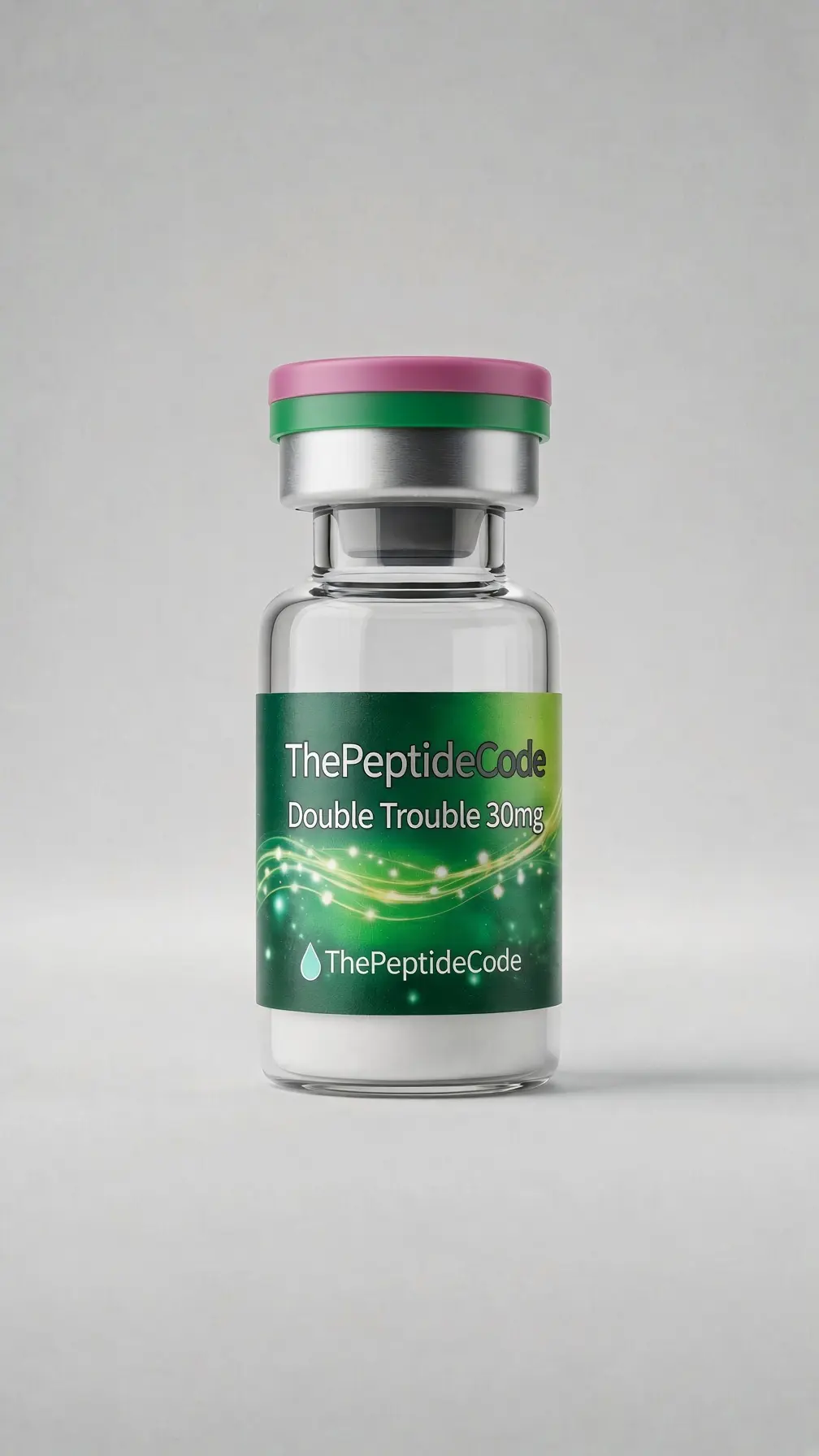
Double Trouble 30mg: Advanced Research Guide
What Is Double Trouble 30mg?
Double Trouble 30mg is a research-oriented peptide product described by its supplier as a dual-agonist research peptide associated with GIP and GLP-1 receptor activity. The product listing identifies it as a 30mg research peptide with stated purity of at least 98% and HPLC and mass-spectrometry verification.
The name “Double Trouble” refers to the product’s dual-receptor research profile. GIP and GLP-1 are both important signaling pathways studied extensively in metabolic and endocrine research.
The 30mg designation describes the labeled quantity of material supplied. It should not be interpreted as a recommended clinical dose or an instruction for human administration.
Because commercial research products can differ in formulation and documentation, researchers should verify the exact identity, composition, purity, and batch information of their specific Double Trouble 30mg product.
Understanding Dual-Receptor Research
Dual-receptor agonists are designed to interact with two biological signaling pathways rather than focusing on a single receptor.
GIP, or glucose-dependent insulinotropic polypeptide, and GLP-1, or glucagon-like peptide-1, are naturally occurring hormones involved in metabolic signaling. Their receptors have been extensively investigated in research involving glucose regulation, pancreatic signaling, gastrointestinal biology, and energy metabolism.
Studying both pathways together allows researchers to investigate whether simultaneous receptor activity produces different biological responses from activation of either pathway individually.
This type of research is useful for understanding receptor interactions and the broader biology of multi-target peptide compounds.
Research Background
Research involving Double Trouble 30mg falls within the broader field of dual-incretin and multi-receptor peptide research.
GIP and GLP-1 receptors are both members of the class B G protein-coupled receptor family. Their signaling pathways have been studied extensively using cellular models, animal models, and clinical research involving different receptor agonists.
Researchers investigate dual-receptor activity to better understand how combined signaling can influence cellular responses and metabolic pathways.
However, findings from one dual agonist cannot automatically be applied to another compound. Molecular structure, receptor affinity, pharmacokinetics, formulation, and experimental conditions can all influence observed results.
Potential Research Areas
Research involving Double Trouble 30mg may be relevant to areas such as:
- GIP receptor signaling
- GLP-1 receptor signaling
- Dual-receptor pharmacology
- Metabolic signaling
- Endocrine research
- Cellular signaling
- Peptide pharmacology
- Receptor interaction studies
- Experimental glucose metabolism
- Pharmacokinetic research
These research areas allow scientists to investigate how two receptor systems interact and how multi-receptor compounds behave in controlled experimental environments.
Researchers should distinguish between established biological mechanisms and preliminary findings from individual experimental studies.
GIP and GLP-1 Receptor Research
GIP and GLP-1 are incretin hormones that have important roles in metabolic signaling.
GLP-1 receptor research has examined signaling associated with glucose-dependent insulin secretion, gastrointestinal activity, and other physiological processes. GIP receptor research has similarly examined nutrient-responsive endocrine signaling and metabolic pathways.
A dual-agonist approach provides a model for studying both receptor systems simultaneously.
For Double Trouble 30mg, researchers should therefore focus on the documented molecular identity and receptor profile of the specific material rather than assuming that all products using similar terminology have identical properties.
Product Specifications
When evaluating Double Trouble 30mg, researchers should review the manufacturer’s technical documentation.
The available product listing identifies the material with the following general specifications:
- Product name: Double Trouble
- Labeled quantity: 30mg
- Research classification: Dual-agonist research peptide
- Receptor research profile: GIP and GLP-1
- Stated purity: ≥98%
- Testing: HPLC and mass spectrometry
- Format: Lyophilized research peptide
- Batch testing: Listed by the supplier
Researchers should confirm these details against the packaging and batch-specific documentation supplied with their product.
Why Purity and Testing Matter
Peptide research requires reliable characterization of experimental materials. Differences in purity, degradation, formulation, or contamination can affect experimental observations.
For Double Trouble 30mg, HPLC can provide information about chromatographic purity, while mass spectrometry can help with molecular identity. These analytical techniques are commonly used in peptide characterization.
A Certificate of Analysis is particularly useful when it corresponds to the specific batch being supplied. Researchers should review the reported purity, identity, batch number, and testing methodology before incorporating a research material into an experiment.
Documentation also helps improve reproducibility between laboratories.
Storage and Handling
Storage requirements should be taken directly from the manufacturer’s documentation for the specific Double Trouble 30mg product.
Lyophilized peptides can be sensitive to environmental conditions, and stability may depend on temperature, moisture, light exposure, packaging, and formulation.
Researchers should follow the supplier’s documented storage recommendations and avoid assuming that storage conditions for another peptide automatically apply to Double Trouble.
Handling should also follow appropriate laboratory procedures and the product’s safety documentation.
Safety Considerations
Research-grade Double Trouble 30mg should not automatically be considered suitable for human administration.
The fact that GIP and GLP-1 receptor pathways have been extensively studied does not establish that a particular research product is approved, safe, or appropriate for human use.
Researchers should distinguish between scientific literature concerning receptor biology or specific clinical compounds and the characteristics of a commercially supplied research product.
Before laboratory use, researchers should review applicable safety documentation and follow appropriate institutional procedures for handling research peptides.
How to Evaluate Double Trouble 30mg
Before selecting Double Trouble 30mg for research, consider:
- Identity: Confirm the exact molecular identity provided by the manufacturer.
- Quantity: Verify the stated 30mg amount.
- Receptor profile: Confirm the documented GIP and GLP-1 research designation.
- Purity: Review the stated purity specification.
- Analytical testing: Check available HPLC and mass-spectrometry information.
- Batch number: Confirm that the product has identifiable batch information.
- Certificate of Analysis: Review batch-specific documentation where available.
- Storage: Follow the manufacturer’s stated storage requirements.
- Research labeling: Confirm that the product is intended for research purposes.
These checks can help researchers assess the quality and documentation of a research material before laboratory use.
Frequently Asked Questions
What is Double Trouble 30mg?
Double Trouble 30mg is a research-oriented peptide product described by its supplier as a dual-agonist research peptide associated with GIP and GLP-1 receptor activity. The listed product has a 30mg quantity and ≥98% stated purity.
Why is it called Double Trouble?
The name refers to its described dual-receptor research profile involving GIP and GLP-1 signaling pathways.
What are GIP and GLP-1?
GIP and GLP-1 are naturally occurring incretin hormones involved in endocrine and metabolic signaling. Their receptors are widely studied in molecular, physiological, and pharmacological research.
What should researchers check before purchasing Double Trouble 30mg?
Researchers should verify the molecular identity, 30mg quantity, purity specification, analytical testing, batch information, Certificate of Analysis, storage requirements, and research-use labeling.
Is Double Trouble 30mg intended for human use?
A research-labeled product should not be assumed to be approved or suitable for human administration. Its intended purpose and applicable safety information should be confirmed from the manufacturer’s documentation.
Conclusion
Double Trouble 30mg is a research-oriented dual-agonist peptide product associated with GIP and GLP-1 receptor research. The available product listing describes a 30mg lyophilized research peptide with ≥98% stated purity and HPLC and mass-spectrometry verification.
Dual-receptor research provides an opportunity to investigate how GIP and GLP-1 signaling pathways interact and how multi-target peptides differ from single-receptor compounds.
Researchers should evaluate the specific product using its technical documentation, including identity, purity, batch information, analytical testing, storage requirements, and Certificate of Analysis where available.


Reviews
There are no reviews yet.