

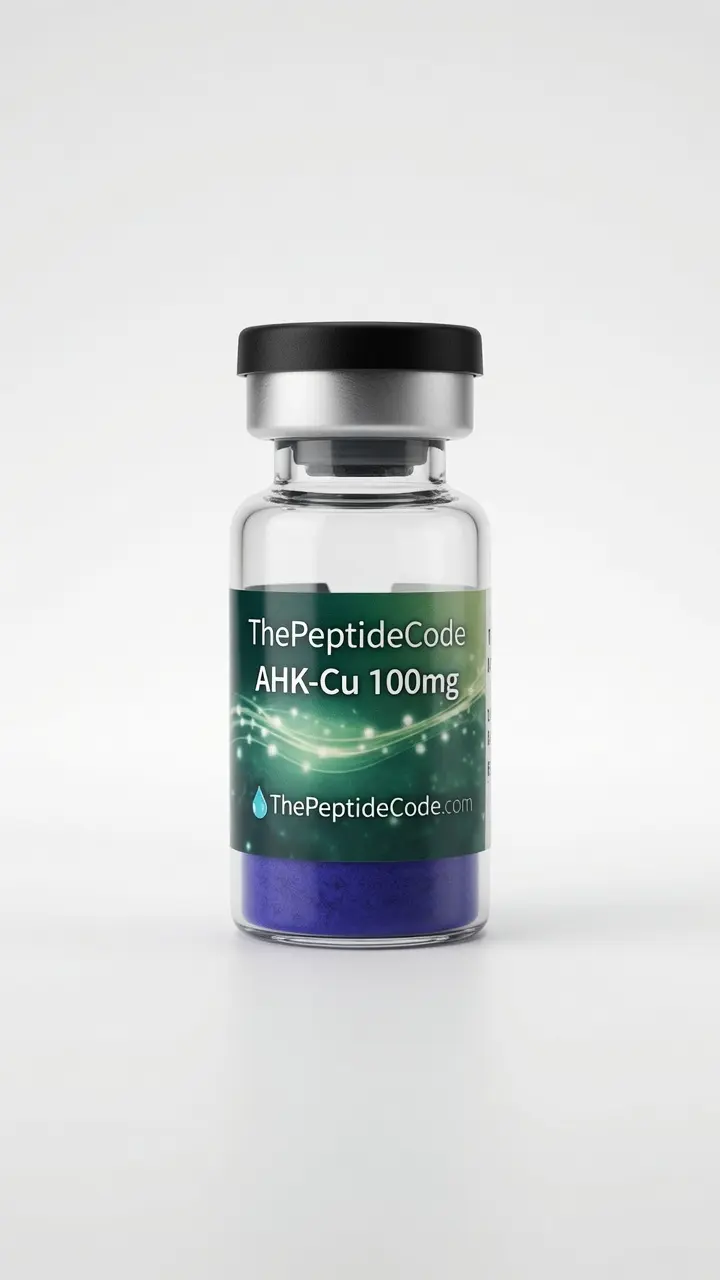
AHK-Cu 100mg: Advanced Research & Safety Guide
What Is AHK-Cu?
AHK-Cu 100mg is a research product containing AHK-Cu, a copper-binding tripeptide composed of alanine, histidine and lysine coordinated with copper. It is structurally related to the better-known GHK-Cu copper peptide, but the two compounds are distinct and should not be treated as interchangeable.
AHK-Cu has been studied primarily in laboratory research involving hair follicles and dermal papilla cells. The available evidence is relatively limited compared with the larger research literature surrounding GHK-Cu.
The exact purity, formulation, salt form and other characteristics of a commercially supplied product depend on the manufacturer and individual batch. Product-specific documentation should therefore be reviewed before evaluating a particular material.
Understanding AHK-Cu
AHK-Cu is the copper complex of the tripeptide L-alanyl-L-histidyl-L-lysine. The copper component is coordinated with the peptide, creating a distinct copper-peptide complex.
The compound is often discussed in connection with cosmetic and dermatological research because laboratory studies have examined its effects on hair-follicle and dermal-papilla models.
It is important to distinguish AHK-Cu from GHK-Cu. Although both are copper-binding tripeptides, they have different peptide sequences and their research evidence should not automatically be transferred from one compound to the other.
Research Applications
AHK-Cu 100mg may be evaluated in laboratory research involving copper-peptide biology, hair-follicle models and dermal papilla cell activity.
A frequently cited study investigated AHK-Cu using isolated human hair follicles and cultured dermal papilla cells. The research examined follicle elongation and cellular responses under controlled experimental conditions. These findings provide a basis for further laboratory investigation but do not establish clinical effectiveness in people.Current evidence should therefore be described as experimental rather than as proof of a treatment effect.
AHK-Cu and Hair Research
Interest in AHK-Cu has largely focused on hair-follicle biology. Laboratory research has examined whether the compound can influence the behavior of dermal papilla cells and isolated hair follicles.
However, laboratory models are different from clinical studies involving people. Results obtained from isolated follicles or cultured cells cannot by themselves establish whether a compound is safe or effective when used on humans.
There are currently no published human clinical trials establishing AHK-Cu as a treatment for hair loss or other medical conditions.
Product Specifications
When evaluating an AHK-Cu 100mg research product, researchers should review the available specifications carefully.
Important information may include:
- Stated amount
- Chemical identity
- Peptide sequence
- Purity
- Salt or complex form
- Batch or lot number
- Certificate of analysis
- Analytical testing
- Packaging information
- Storage requirements
- Manufacturer information
- Research-use designation
The stated 100mg amount describes the quantity supplied and should not be interpreted as a recommended human dose.
Why Purity and Documentation Matter
Research compounds can differ between suppliers and batches. A certificate of analysis, when available, can provide useful information about the identity and analytical characteristics of a specific batch.
Researchers should verify that documentation corresponds to the actual product and lot being evaluated. Generic information about copper peptides does not necessarily establish the composition or quality of a particular AHK-Cu product.
Independent analytical testing can provide additional information about purity and identity where available.
Storage and Handling
Storage requirements depend on the specific formulation and manufacturer’s instructions. Researchers should follow the product-specific documentation rather than assuming that every AHK-Cu formulation has identical storage requirements.
For lyophilized research materials, the supplier’s instructions should be followed regarding temperature, light exposure, moisture and packaging. Some suppliers specify refrigerated or frozen storage for their particular products, but these conditions should not be generalized to every formulation.Appropriate laboratory procedures should also be followed when handling research materials.
Safety Considerations
The direct safety evidence for AHK-Cu is limited. Available research is predominantly laboratory or preclinical, and there is no established human clinical safety database specific to AHK-Cu.
AHK-Cu 100mg should not be assumed to be approved for injection, ingestion or other human use simply because it is supplied as a research product.
Researchers should consult the manufacturer’s documentation and applicable laboratory safety requirements before handling or evaluating the compound.
Claims based on the broader GHK-Cu literature should also not automatically be presented as evidence for AHK-Cu.
How to Evaluate an AHK-Cu Product
Before purchasing or evaluating a research material, check for:
- Clear product identification
- Stated quantity
- Chemical identity
- Purity information
- Batch or lot identification
- Certificate of analysis where available
- Analytical testing
- Storage instructions
- Manufacturer information
- Research-use designation
Reliable, batch-specific documentation is more useful than relying solely on online descriptions or testimonials.
Frequently Asked Questions
What is AHK-Cu 100mg?
AHK-Cu 100mg is a research product containing a stated 100mg amount of AHK-Cu, a copper-binding tripeptide made from alanine, histidine and lysine.
Is AHK-Cu the same as GHK-Cu?
No. Both are copper-binding tripeptides, but they have different peptide sequences. Research findings for GHK-Cu should not automatically be attributed to AHK-Cu.
What is AHK-Cu studied for?
Research has primarily examined AHK-Cu in hair-follicle and dermal-papilla-cell models, including studies of follicle growth and cellular activity.
Has AHK-Cu been tested in human clinical trials?
The available literature does not establish published human clinical trials demonstrating its safety or effectiveness for hair growth or skin-related treatment. The principal evidence is laboratory and ex vivo research.What should I check before purchasing?
Review the product identity, stated amount, purity, batch information, certificate of analysis where available, storage requirements and research-use designation.
Important Disclaimer
This page is provided for research and educational purposes only. The available evidence concerning AHK-Cu is primarily preclinical, and laboratory findings do not establish suitability for medical treatment or human use.
Always follow the manufacturer’s documentation, applicable laboratory procedures and relevant safety requirements.

Reviews
There are no reviews yet.