

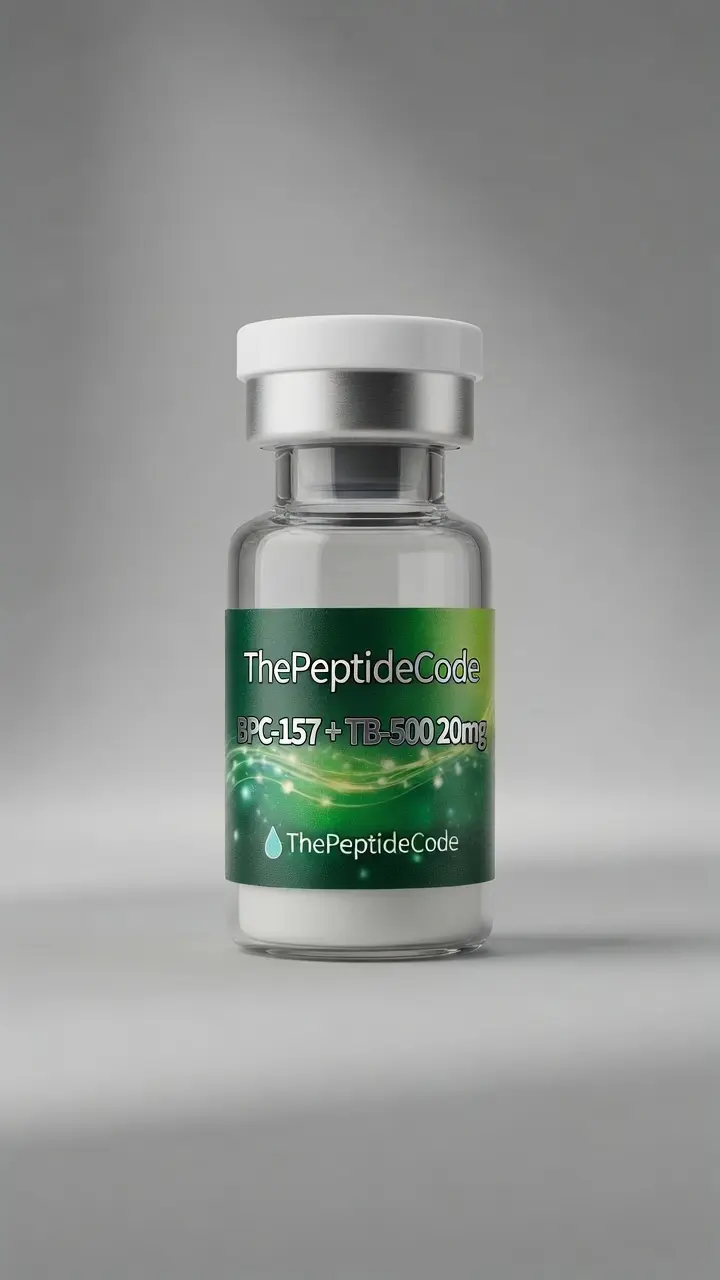
BPC-157 TB-500 Blend 20mg: Complete Research Guide
What Is BPC-157 TB-500 Blend 20mg?
BPC-157 TB-500 Blend 20mg is a two-peptide research formulation containing BPC-157 and TB-500. Current product listings commonly describe the 20mg version as a 1:1 blend containing 10mg of BPC-157 and 10mg of TB-500.
BPC-157 and TB-500 are chemically distinct peptides. Although they are frequently discussed together in research and commercial literature, research involving one component should not automatically be interpreted as evidence for the complete combined formulation.
The 20mg designation refers to the total labeled quantity of the two peptides. Researchers should verify the exact composition, purity, batch information and testing documentation for the specific product being evaluated.
BPC-157 Research Background
BPC-157 is a synthetic pentadecapeptide that has primarily been investigated in preclinical research. Scientific studies have explored its biological activity in experimental models involving cellular signaling, vascular processes, gastrointestinal biology and tissue-related pathways.
Much of the research surrounding BPC-157 remains preclinical. Laboratory and animal findings can help researchers investigate biological mechanisms, but they do not automatically establish clinical effectiveness or safety in humans.
Within a BPC-157 TB-500 Blend 20mg, BPC-157 represents one half of the nominal total quantity when supplied as the commonly listed 10mg + 10mg formulation.
TB-500 Research Background
TB-500 is commonly described as a fragment related to thymosin beta-4. Research involving thymosin beta-4 and related peptide fragments has examined biological processes including cellular migration, cytoskeletal activity and tissue-related signaling.
An important consideration is that terminology surrounding TB-500 can vary between commercial sources. Researchers should confirm the exact chemical identity of the material rather than assuming that every product labeled TB-500 is identical to full-length thymosin beta-4.
FDA materials specifically identify TB-500 as the thymosin beta-4 fragment LKKTETQ and report that human exposure data for drug products containing TB-500 were not identified in the agency’s review.
BPC-157 TB-500 Blend 20mg Research Applications
BPC-157 TB-500 Blend 20mg may be relevant to laboratory investigations involving multiple peptide pathways.
Potential research areas include:
- Peptide biology
- Cellular signaling
- Cell migration
- Vascular research
- Tissue-related biological pathways
- Peptide-receptor interactions
- Structure-activity research
- Multi-component peptide formulations
- Analytical peptide research
Studying the two peptides in a combined formulation can provide a framework for investigating multi-component peptide systems.
However, researchers should distinguish between component-level evidence and blend-level evidence. The existence of studies involving BPC-157 or thymosin beta-4-related peptides does not establish that the combined BPC-157 TB-500 Blend 20mg has the same biological effects.
Understanding the 20mg Composition
The commonly listed formulation contains:
- BPC-157 — 10mg
- TB-500 — 10mg
- Total — 20mg
This represents a 50/50 composition by labeled peptide quantity.
Because it is a fixed-ratio blend, the two components should be considered together when evaluating the product specification. Researchers should not assume that a different BPC-157-to-TB-500 ratio applies to every product using a similar name.
The exact product documentation should take priority over generic online descriptions.
Product Specifications and Quality
When evaluating BPC-157 TB-500 Blend 20mg, researchers should review the complete product documentation.
Relevant information can include:
- Exact peptide identities
- Quantity of each component
- Total labeled quantity
- Purity
- Batch or lot number
- Analytical testing
- Certificate of analysis
- Physical formulation
- Manufacturing information
- Storage requirements
A certificate of analysis can provide batch-specific information about peptide identity and purity. Some suppliers report separate analytical results for each component rather than testing the finished blend as a single material. This distinction is important when interpreting laboratory documentation.
Storage and Handling Considerations
Peptide materials can be affected by environmental conditions such as temperature, moisture, light and unsuitable handling. BPC-157 TB-500 Blend 20mg should therefore be stored according to the manufacturer’s product-specific instructions.
Storage requirements can vary depending on whether the material is supplied as a lyophilized powder, pre-mixed formulation or another presentation.
Researchers should avoid applying storage instructions from an unrelated peptide product. The manufacturer’s documentation for the specific batch should be treated as the primary reference.
Maintaining the original packaging, lot number and certificate of analysis can also help preserve accurate laboratory records and product traceability.
Safety and Regulatory Context
BPC-157 and TB-500 are subjects of ongoing regulatory review in the United States. In July 2026, an FDA Pharmacy Compounding Advisory Committee meeting included BPC-157-related and TB-500-related bulk drug substances among the substances being considered for the 503A Bulk Drug Substances List. FDA stated that its briefing materials were prepared for advisory discussion and that no final determination would be made until the review process was completed.
FDA materials also state that compounded drugs containing BPC-157 may present potential immunogenicity and peptide-impurity concerns and that the agency has limited safety information for proposed routes of administration. Similar concerns were identified for TB-500, including potential aggregation and peptide-related impurities.
These regulatory considerations should not be interpreted as a determination about every commercially marketed research product.
Understanding the Evidence
The research evidence for BPC-157 and TB-500 should be evaluated separately from evidence concerning their combination.
BPC-157 research is largely preclinical, while FDA’s review reported no identified clinical studies or human exposure data involving TB-500 drug products.
Consequently, claims about a BPC-157 TB-500 Blend 20mg should not go beyond what the available evidence supports. Research involving individual components can provide background information, but it does not establish the safety or effectiveness of the finished blend.
This distinction is particularly important when creating product descriptions that are intended to remain scientifically accurate.
Final Considerations
BPC-157 TB-500 Blend 20mg is commonly presented as a two-peptide research formulation containing 10mg BPC-157 and 10mg TB-500.
The two peptides have different structures and research histories, making accurate product identification important. Researchers should review the exact composition, batch-specific testing, purity information, certificate of analysis, storage requirements and applicable regulatory framework.
Scientific literature concerning BPC-157 or TB-500-related compounds should also be distinguished from evidence directly evaluating the combined 20mg formulation.


Reviews
There are no reviews yet.